Showing posts with label Homeschool Science. Show all posts

Wednesday, July 28, 2021

Young Scientist Earth & Space Science course from Greg Landry's Homeschool Science Review

Disclosure:  I received this complimentary product through the HOMESCHOOL REVIEW CREW.
Greg Landry's Homeschool Science

Today, I am sharing about the Young Scientist Earth & Space Science course from Greg Landry's Homeschool Science.  D is currently working her way through this online course this summer.  She is currently halfway done.
 
 
This is a self-paced 4th-7th grade one-semester class.  It is geared for upper elementary or junior high students.  I appreciate that the online recordings can be watched at your students convenience and even rewatched if necessary (this can even be run at 1.5/2 times normal speed making it even faster the second time around).
 
 
Another cool aspect of this course is that it includes a PDF version of the information/book (~100 pages).  You can see we have access above.  You can use this online or print it out if you desire.  There is also a black and white version for printing if you'd like to save ink.  There are also worksheets and other resources for students to use as they work their way through this course.

Above you can see the Chapter 1 student Worksheet.

 
There is a nice ~30 minute class introduction for students and parents that help you get a feel for the class set-up and what to expect.  Our Young Scientist Earth & Space Science course has 13 classes and the topics include 
  • Note-Taking, Studying & Test Taking
  • Metric System, Temperature, Precision & Accuracy
  • Scientific Method & Lab Reports
  • Mapping, Latitude & Longitude
  • Time zones, International Dateline & Prime Meridian
  • Unique Landmarks & Other Fun Stuff
  • Ocean Tides
  • Atmosphere, Climate & Weather
  • The Heavens I
  • The Heavens II
  • Rock, Minerals, Ores and Fossils
  • Earthquakes & Volcanoes
  • Landforms
I want to note here that this course is done through a Christian perspective, which I personally love.  Every class begins with a short prayer.

D watching Class #2.
 
A Probability, Accuracy and Precision worksheet from Lesson 2.

Learning about The Scientific Method and Lab Reports in Class #3

Each class has a video lesson taught by Greg Landry (a homeschool father and former college professor) that average to be 20-30 minutes in length.  Class #2 exceeds this as it is ~ 55 minutes in length and there are a few that are under 20 minutes but for the most part, they hit the 20-30 minute range.
 

I like that students and parents can ask Professor Landry questions through email using this course.  Because this course is self-paced, there is tons of freedom in completing it quickly or at a slower pace.  And likewise, you can use as much of the material that's presented or less if desired.  This course emphasizes the process of taking notes because students tend to remember much more of what they write over what they hear.  So it is recommended to have some kind of binder or notebook.  D has been using a 1 subject notebook and a box of colored pencils and that's worked great for her.  We also have a 3-ring binder for her worksheets and extra material.

D has been enjoying this course and it has been a really good fit for her to work through it this summer.  I'm thinking about having E do it after her as well as she is going into 4th grade this Fall.  If you are looking for self-paced, online, science courses you will definitely want to check out Greg Landry's Homeschool Science options.

There are other self-paced 4th-7th grade one-semester classes offered including Young Scientist Anatomy & Physiology, Young Scientist Biology, Young Scientist Chemistry and Young Scientist Physics.  There are also self-paced 7th-12th grade half-semester classes (Exercise & Sports Physiology, Biochemistry/Microbiology, Embryology/Endocrinology and Earth & Space Science) as well as virtual, interactive labs.
 
Be sure to click on the banner below to visit the Homeschool Review Crew blog to read more reviews of Greg Landry's Homeschool Science.

Online College Prep Science Classes with Greg Landry

You can engage and learn more by heading over to Greg Landry's Homeschool Science.

Thursday, May 30, 2019

Supercharged Science Review


I am super excited to share this post with you!  Supercharged Science generously provided our family with a full year of access to e-Science Homeschool Science Curriculum for all levels, K-12.  There are over 700 different experiments, projects, and activities within this e-Science program.  Obviously we cannot do them all and that's okay.

Aurora Lipper

Aurora Lipper's (the creator of Supercharged Science) main goal is to provide science education to families and teachers while helping people learn new things and enjoy science as much as she does.  Rather than focusing on quantity and trying to do all experiment, projects and activities offered she encourages quality and a love of learning.  You pick the activities that fit both your time and budget.  Aurora is talented and a phenomenal teacher.  She is a mechanical engineer, university instructor, pilot, astronomer, and mom.  She has been teaching science classes and workshops since 1999!  This curriculum utilizes lots of pre-recorded video lessons taught by Aurora.  I believe there are over 1000 videos!  Don't get intimidated though.  Most of these videos are bite-sized lessons ranging from 5-20 minutes long, followed by an activity.  Aurora helps science come alive.

There are two main ways to approach this program:  topics and grade levels.  Within the topics section you will find all kinds of material on the Scientific Method, Sound, Motion, Thermodynamics, and so much more appropriate for a range of ages.  Whereas, within the grade levels section you will hit on multiple areas in a given year.  For example, 7th grade includes Life Science, Energy, and Physics of Light and Lasers.

 Here you can see the program by grade levels.  You just click on the level you want to begin.  The Advanced Topics section includes high school material.


And here you can see the program divided by topics.

How to start?  Find a study unit you want to use or something that piques your interest.  Watch the videos and dive right into the activities.  With each experiment there is an itemized shopping list.  You can use these lists to locate ones that you already have the materials for.  So far, we have had all the materials on hand that were needed to complete the activities.  Let me walk you through some of them.

Within the PreK/K Life Sciences we found a fun activity of making a plant press.  I decided to do this with F and G and we had a blast.

First, we watched the plant press video.

 Next, we went on a walk to find flowers and leaves.

 Setting up our leaves and flowers

Then, we pressed out flowers.  I love that Aurora gave several different ways to make a plant press using different materials.  We used paper, cardboard and a belt as one of the ways suggested.  After several days, our flowers and leaves were set.  We laminated them and made fun bookmarks!

 A few of our bookmarks


Another fun experiment within the  PreK/K Physics section was making our own harmonica using household items.  We made ours using supplies we already had:  craft sticks, construction paper, scotch tape, and rubber bands.

Instructional Video

Our Homemade Harmonica

F playing it

 C having a turn

 You can actually slide the cuffs closer together or further apart to alter the pitch.

We also picked topics to work on beginning with the Scientific Method.  My older kids enjoyed finding out how many drops of water they could fit on a penny.

Penny Experiment

A was able to get 43 drops before the water spilled off the top.

A close up of the penny with water

When we repeated the experiment we again got 43 drops.  This led us the kids to wonder how many drops of water they could fit on a dime.

B practicing with the pipet.

 We were able to get the dime to hold 50 drops of water before spilling!

This curriculum can be used by itself or alongside another one as a supplement.  We are loving the hands-on experiments and I love the use of common everyday materials that make this curriculum economical.  My kids read about experiments and do them!  They love that.  All kinds of learners can thrive with e-Science Homeschool Science Curriculum as there are readings, experiments, exercises and videos.  Auditory learners will appreciate the teleclasses and videos.  

Geology Teleclass available

Kinesthetic and visual learners will enjoy watching the videos and doing the experiments and activities.  Digital learners will love the text downloads and website reading about the experiments.  There is something for everyone!

Unit 18 Biology Part 1 (There are 60 pages in this download)

Another thing worth noting is that this curriculum works for both secular and religious viewpoints as it is designed from a creation-neutral perspective.  If you have science questions or need help, there is science question support and Aurora is happy to help.

Be sure to click on the banner below to visit the Homeschool Review Crew blog to read more reviews of award-winning Supercharged Science.  I'm really looking forward to incorporating this curriculum into our upcoming school year even more!

e-Science Homeschool Science Curriculum {Supercharged Science Reviews}

You can engage with Supercharged Science on social media @:


Crew Disclaimer 

Wednesday, May 22, 2019

Big Bible Science by Christian Focus Review


It has been fun using Big Bible Science by Christian Focus as a supplemental science addition to our homeschool.  The recommended ages for RTM (Read to Me) is 5-7; whereas, the recommend ages for RM (Read Myself) is 7-11.


We are enjoying using this book as a family.  Most of my older kids (A, B, and C) are familiar with the concepts that are taught; whereas, the concepts are definitely new for my younger crowd (D, E, F and G).  However, there is always something to be learned or discover regardless of age.  What topics are included in this book?  This book discusses gravity, Newton's Laws of Motion, Friction, Static Electricity, Acids and Bases, Combustion, Lunar Craters, Water Cycle, Basic Animal Classification, Anatomy and more!

There are 21 chapters or units in this book (referred to as Experiments).  Above you can see Chapter 7 which is on Acids and Bases.


If you haven't guessed from the title, this curriculum uses the Bible and is taught through a Christian worldview.  Each chapter contains a scripture verse that reinforces the science concept being taught!  You are encouraged to begin each lesson in prayer - for God to open the minds of your children and help them concentrate, for the teacher to have patience (that's me), and for everyone to enjoy learning about God's creation - I love this.  The core of this curriculum is learning about God's Word while learning about God's world as they are closely associated with one another.


In addition, each chapter has six main components:  objectives (the science learning goals), materials list (what you will need for the lesson), the big idea section (explains the lesson scientifically and ties in the biblical perspective and verse), activities (scientific demonstrations, games and experiments), an apply it section (ideas on how to find examples of the lesson in the world) and a go beyond section (challenges advanced and older students to think and experiment further).  Each lesson is fairly short, 2-4 pages and the entire softcover book is under 100 pages.  I think these shorter lessons keep the kids engaged and asking questions.  The younger kids were less likely to get distracted.  The experiments worked really well in our homeschool environment as the materials and supplies were easily found around our home and the kids were eager to participate.  The kids appreciated the color illustrations and photographs.

We learned about static electricity in unit 6.

 We learned about combustion reactions in unit 8.

Unit 10 took us to space as we explored lunar craters.

A sampling of our craters.

Lunar craters rock!

 Units 13 and 14 helped us learn basic animal classification.

 Classifying our animals into mammals, birds, reptiles, amphibians and fish.  We even had a small group of invertebrates.


Two other sections worth noting are the notebooking page near the front of the book and the mini biographies located at the back of the book.  I just finished teaching a Science Fair course at our weekly CoOp and I really appreciate the section on good habits for a young scientist.  There are great tools and tips for keeping a science notebook.


There are 11 mini biographies to look through at the very end of the book.  Our family found these interesting.

Additional activities to accompany this book can be found on the book's page online (Big Bible Science) under additional downloads.  We checked them out and enjoyed the extra activities for learning about the water cycle.

 Example of additional activities found online

The kids really enjoyed reading A Drop Around the World by Barbara Shaw.

This is just a sampling of the fun we have had so far as we journey through this book.  If you are looking for a science book that incorporates the Bible in a fun and exciting way for your young learners, then this is the book for you.  I love watching science come alive with my kids as they continue to explore and ask questions about the world in which we live.  May my kids continue to grow their minds and love for Christ in all that they do.


Be sure to click on the banner below to visit the Homeschool Review Crew blog to read more reviews of Big Bible Science as well as other books from Christian Focus.

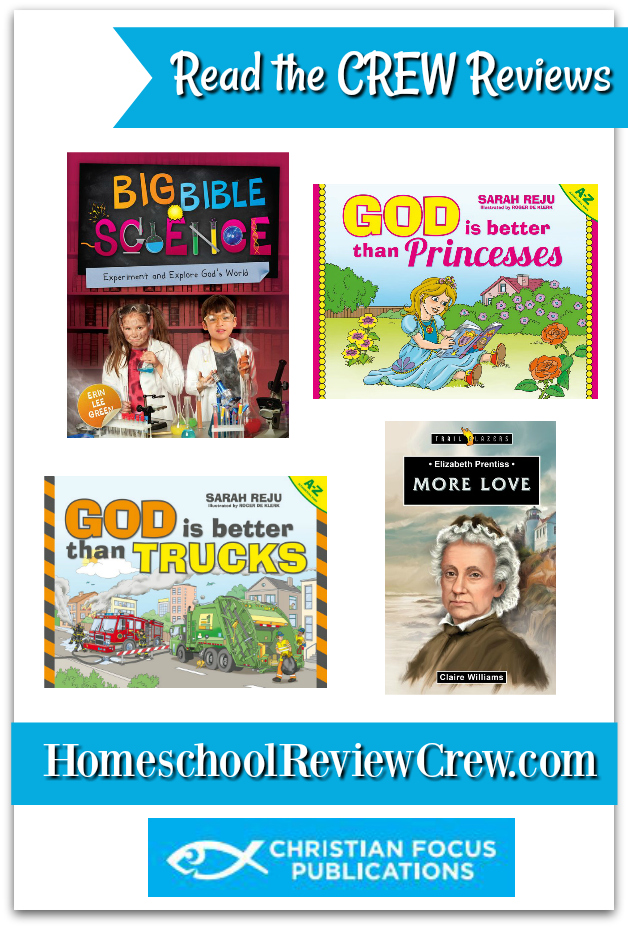
Big Bible Science, Elizabeth Prentiss, God is Better than Princesses,  God is Better than Trucks. {Christian Focus Reviews}
You can engage with Christian Focus on social media @:


Crew Disclaimer