

You guys know how much we enjoy learning about space! Today I want to share with you the tech-based learning discovery experiences of the Solar System Online Unity Study from Techie Homeschool Mom.

Solar System Online Unity Study
Who is this for? The online unit study is designed for children mid-elementary to middle school age who can read and navigate the Internet on their own (students access websites, videos and complete digital projects). Younger children can participate with assistance. We chose to do this study together as a family. Although G and F (2 and 5) mostly played with their rockets and I had them complete a Solar System puzzle.

F and G with their puzzle
What materials do you need? Along with the outside book that you choose to read as a companion (you could choose a book that you already own or check one out at the local library), you will need some supplies for hands-on projects. And since it is a digital study, you will need a computer or device with Internet access to use it.
How is it scheduled? How long do you have access? This course is self-paced. You can choose to do bite sized lessons or sit down and tackle larger chunks in less time. This is what we chose to do. Again, flexibility. The completion time for this course will vary depending on how you chose to approach it but it is estimated that each module takes around 2-3 hours to complete. I say each module because there are various to choose from: Ancient Egypt, Ancient Greece, Ancient Rome, Famous Artists Vol. 1, Famous Artists Vol. 2, Famous Inventors and Solar System. Once you enroll, you have unlimited access to this course across all devices that you own. Sweet.
What content does this digital study cover? This course focuses on:
- Solar System Overview
- The Sun
- Planetary Orbits
- Gravity
- Planets
- The Rocky Planets
- The Gas Planets
- Comets, Asteroids and Meteors
Within each section there are videos, information and hands-on projects for each topic. Students are introduced to Google Sheets and shown how to record and evaluate scientific data. There is also a Book Club section in which you are encouraged to select an outside book to read along with your study. Suggestions are listed but you can ultimately pick your own book that goes along with the Solar System theme. This study concludes with a final project of creating a solar system model.
How did we use it? First, we chose to use our YWAM Publishing Heroes of History Alan Shepard for our Book Club book since it lined up for us really well. Secondly, as I mentioned above we sat down for larger chunks to work on our study. There is a nice section at the very beginning called Before You Start that includes a great list of project supplies needed. I skimmed through this and determined that we had everything we would need already. Score. We also used our Ipad for most of this course. We did move to our PC when making Google sheets.

Solar System Online Unit Study
The website is user friendly and easy to navigate. As you can see above it has each main section listed in the left column of the site. As you go through and complete the course, the bar at the top will show you your progress. Above it is at 24% complete. There is also a previous button arrow that takes you back as needed along with a complete and continue button that continues through the course.


Watching the video

My kids enjoyed watching this video explaining the scale of the Solar System.
The kids really liked the videos. They were fun and engaging. What's an example of a hands-on project? The kids first hands-on project was to create a chalk pastel of the solar system using one of the images provided. This was a simple activity and the kids had fun making their pictures.
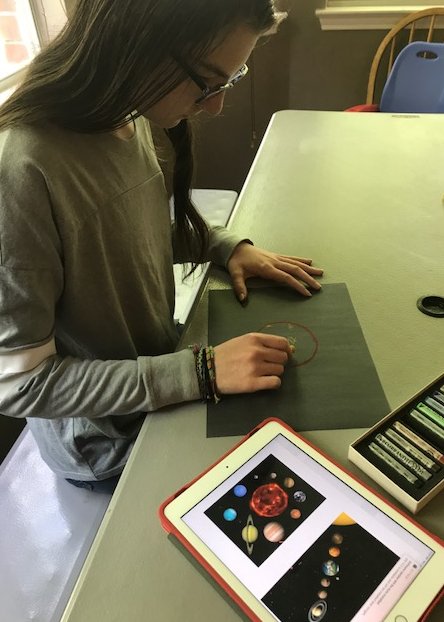
A starting her chalk pastel

Completed Work

D and E choose the same image. Here is E with her completed work.

And D

Here is C's finished work.

Artwork side by side

Within the Sun Spot Lab project the kids created their first Google sheet using the data provided for sun spot activity from 1960-2014. The kids had never done this before so I helped. There are other opportunities for them to make more Google sheets within this course.

After making their sheet and line graph, there was a 4 question quiz within the lesson that referred to their chart.

Quiz
The questions were simple but I liked it because it helped the kids use their graph and think about what the data meant. There are several interactive opportunities throughout this course.


The kids are working on a few things for their final project. This is the Play-Doh Solar System model they created but they know that it isn't completely to scale. They are also planning on adding in moons and details. I am having them think of more ideas of ways they could make a Solar System model. Stay tuned!
I don't want to show you everything that we did in this study but I hope that I have shared enough that you have an idea of the feel of this online study. My family has enjoyed it.

I look forward to checking out the other modules from Techie Homeschool Mom, especially Famous Inventors.


